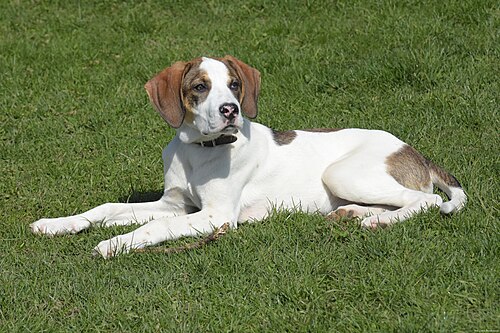
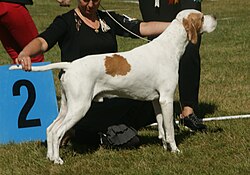
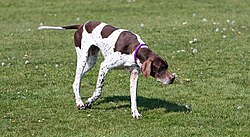
English Pointer
🧠 Temperament & character
In the field the English Pointer is an energetic specialist with an enormous need to run, a wide search and intense concentration. In the house, by contrast, he shows himself astonishingly calm, friendly and affectionate, a pleasant, gentle companion. He is sensitive and people-oriented and responds best to friendly, patient guidance. His pronounced hunting drive and his need for exercise, however, call for consistent activity.
📜 Origin & history
The English Pointer developed from the 17th and 18th centuries in England out of Spanish and Portuguese pointing dogs, refined by crossings of Foxhound, Greyhound and Setter for pace, stamina and a fine nose. The aim was a specialised dog that locates feathered game and indicates it in an elegant pose so that the hunter can approach. Thus arose the epitome of the pointing dog, which shaped numerous other breeds worldwide. To this day he is regarded as the benchmark for pointing performance.
✂️ Grooming, care & training
The short, smooth coat of the English Pointer is extremely easy to care for and needs only occasional brushing. His need for exercise, however, is enormous: he needs extensive daily opportunities to run and race freely as well as mental occupation, otherwise he is not a happy dog. As a sensitive specialist he responds well to friendly, motivating training, and a reliable recall should be practised early. His thin coat offers little protection from the cold, which is why a coat can be sensible in the Swiss winter.
🩺 Health
The English Pointer is considered a fundamentally robust, sporty breed with a life expectancy of around twelve to fourteen years. Occasionally hip dysplasia, skin problems and ear infections occur; rarely hereditary neurological diseases appear. Responsible breeders x-ray the hips and pay attention to healthy, temperamentally steady lines. Overall the Pointer is a long-lived, vital dog.
🏡 Who is this breed right for?
The English Pointer suits very active, enduring people and hunters who offer him plenty of running room and tasks every day. For quiet households or pure apartment keeping without intensive exercise he is unsuitable, even though he is pleasantly calm in the house. In Switzerland he is suitable for sporty owners who are out and about a lot as well as for hunting feathered game. As a pure beginner's dog he is only suitable with reservations because of his urge to move and his hunting drive.