English Foxhound
🧠 Temperament & character
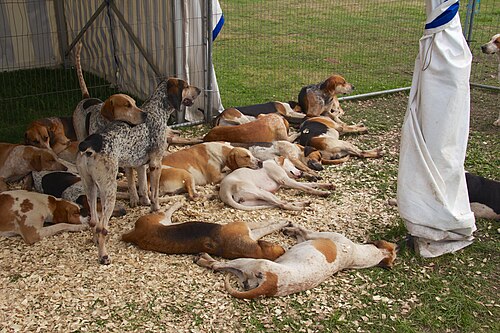
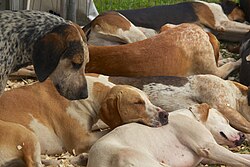
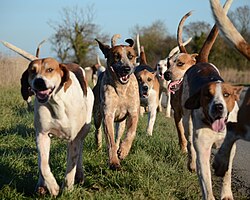
The English Foxhound is sociable, even-tempered and good-natured – a thoroughly pack-oriented dog that loves the company of its own kind and of people and dislikes being alone. It has enormous stamina, a fine nose and an independent, running-loving character. With children and other dogs it is usually uncomplicated and sociable. Its strong hunting instinct and its independence, however, make it a dog that needs plenty of exercise and clear leadership.
📜 Origin & history
The English Foxhound was bred deliberately in England from the 16th and 17th centuries onwards for mounted fox hunting, in which large packs chased the fox over long distances. For centuries the hunting societies selected their dogs carefully for nose, stamina, speed and pack compatibility. The English Foxhound is regarded as one of the ancestors of numerous other scent hound breeds, including the American Foxhound. To this day it is above all a working and pack dog and hardly a pure house dog.
✂️ Grooming, care & training
The English Foxhound's short, dense coat is weatherproof and very easy to care for; occasional brushing is enough. Its enormous need for exercise, on the other hand, is demanding: it needs hours of activity every day, extensive running and mental occupation, ideally with a real task. Without enough exercise, this enduring pack hound can hardly be kept in a species-appropriate way. In training it needs a consistent hand, plenty of socialisation and a securely fenced environment, since its hunting instinct is strong and its recall is poor.
🩺 Health
The English Foxhound is considered a robust, long-lived breed and usually reaches an age of ten to thirteen years. Thanks to centuries of functional breeding for performance, it is very healthy overall; breed-typical hereditary diseases are rare, and hip dysplasia occurs only occasionally. As with all large, active drop-eared scent hounds, one should pay attention to the ears, the joints and – as with deep-chested breeds – the risk of gastric torsion. Responsible breeders X-ray the hips and pay attention to health and working aptitude.
🏡 Who is this breed right for?
The English Foxhound is a thoroughly pack- and work-oriented dog and fits almost exclusively into a hunting or very sporty environment with plenty of space and experience. For a city apartment, for beginners or for quiet households it is hardly suitable, as it needs an enormous amount of exercise, company and a task. As a sociable pack dog it feels most content in the company of other dogs and should not be kept alone. In Switzerland it is very rare; outdoors, securing it and observing the leash and wildlife-protection rules are essential because of its strong hunting instinct.