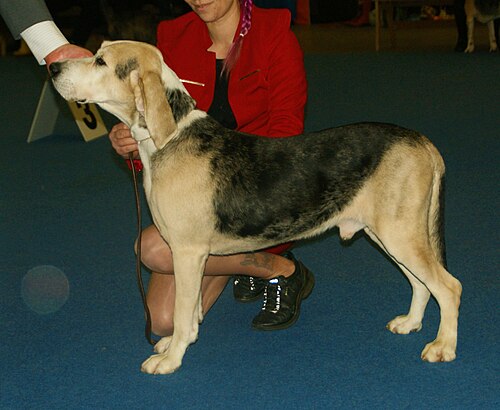
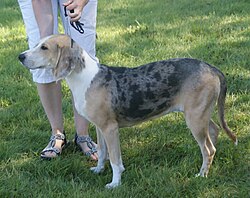
Dunker
🧠 Temperament & character
The Dunker is friendly, calm and robust – a balanced scenthound with a good-natured, sociable nature. He possesses an excellent nose and plenty of stamina and works the trail with concentration and persistence. He usually gets on well with children and other dogs and shows himself to be a pleasant, balanced companion. His hunting drive, however, remains pronounced, which is why he needs plenty of exercise and scent work.
📜 Origin & history
The Dunker was developed in the 19th century by the Norwegian Wilhelm Dunker, after whom the breed is named. He crossed various scenthounds, among others with blue-marbled (harlequin) dogs, to create an enduring hare hound with a fine nose for Scandinavian conditions. Characteristically, the Dunker tracks the hare by scent and not by sight. To this day he is widespread above all in Norway as a hunting dog and is rare outside Scandinavia.
✂️ Grooming, care & training
The Dunker's short, dense coat is weatherproof and very easy to care for; occasional brushing suffices. He needs regular, extensive exercise and plenty of scent work to be physically and mentally occupied, and feels comfortable even in cold and snow. Without enough occupation this enduring runner becomes restless. In training he is pleasant thanks to his calm, sociable nature, but he follows his nose; the ears should be checked regularly.
🩺 Health
The Dunker is considered a fundamentally robust, healthy breed with a life expectancy of about twelve to fourteen years. The merle issue should be noted: in blue-marbled (merle) lines deafness and eye problems can occur, which is why merle must under no circumstances be mated with merle. Otherwise, as with all drop-eared scenthounds, one should pay attention to the ears, the joints and the paws. Responsible breeders avoid merle-x-merle matings and pay attention to hearing, eyes and health.
🏡 Who is this breed right for?
The Dunker suits active people and families who value a calm, friendly hunting dog with plenty of stamina and can offer him enough exercise and scent work. For a city apartment or for very easy-going owners he is less suitable because of his need for exercise and his hunting drive. He is sociable and should not be left alone much. In Switzerland he is a distinct rarity and almost only to be encountered in a hunting context; outdoors, securing him and observing the leash rules are important.