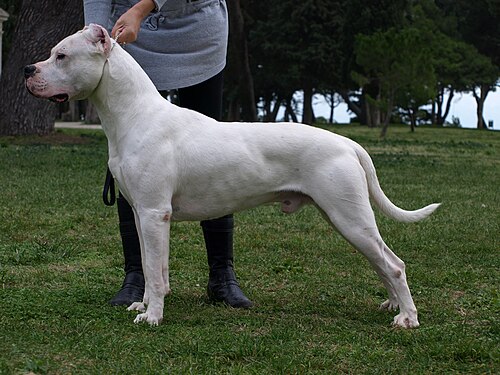
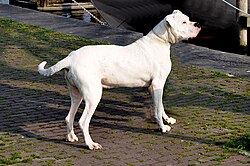
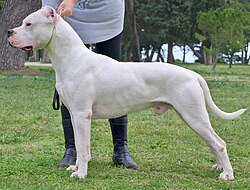
Dogo Argentino
🧠 Temperament & character
The Dogo Argentino is powerful, courageous and deeply loyal towards his family. He is people-oriented and can be very gentle and affectionate, but has a pronounced protective instinct and self-confidence. As an original hunting dog he can show a marked hunting drive and dominance towards other dogs. Early socialisation, clear boundaries and fair, self-assured guidance are therefore essential.
📜 Origin & history
The Dogo Argentino was bred in the 1920s by the Argentine doctor Antonio Nores Martínez, who wanted to create a courageous, enduring hunting dog for wild boar and puma. The foundation was the now-extinct Perro de Pelea Cordobés, supplemented by Great Danes, Boxers, Pointers, Bulldogs and other breeds. This produced a white, powerful and weatherproof pack-hunting dog that was also intended to serve as a family and guard dog.
✂️ Grooming, care & training
The short, pure white coat of the Dogo Argentino is very easy to care for; the pale skin, however, is sensitive to the sun and needs protection on hot days. His need for exercise is high: the athletic dog wants to run, work and be mentally challenged for long stretches every day. Without sufficient activity he tends towards restlessness and unwanted behaviour. He is intelligent and willing to learn but needs consistent training from an early age and plenty of positive socialisation.
🩺 Health
The Dogo Argentino is overall a robust breed, but like many white dogs he has an increased risk of pigment-related, hereditary deafness in one or both ears. Hip dysplasia also occurs. Responsible breeders carry out a BAER hearing test on the puppies and x-ray the hips of the parent animals. Life expectancy is around ten to twelve years.
🏡 Who is this breed right for?
The Dogo Argentino is a dog for experienced, active owners with time, consistency and leadership strength – he is not suitable for beginners. He needs plenty of exercise, occupation and a home with space, ideally with a garden. In Switzerland he is classified as a potentially dangerous breed in several cantons and appears on breed lists; keeping, permit requirements and mandatory training are regulated differently depending on the canton and absolutely must be clarified beforehand. Anyone who meets these conditions will find in him a loyal, impressive companion.