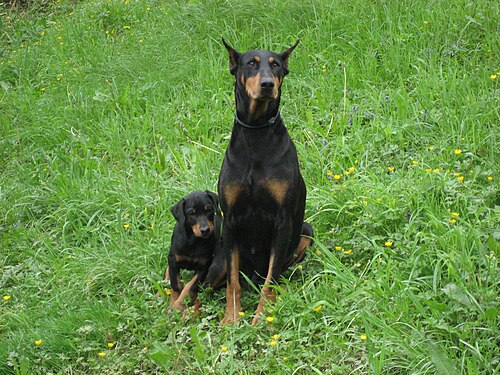
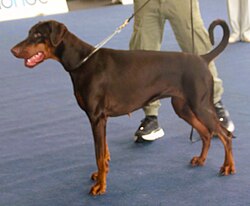
Dobermann
🧠 Temperament & character
The Dobermann is intelligent, self-confident, brave and at the same time remarkably affectionate and family-oriented. He is very willing to learn and works closely with his person, but needs consistent, self-assured guidance. Well socialised, he is a dependable, balanced companion who attentively protects his family, including the children. Towards strangers he is watchful, but should never be nervous or excessively sharp – a sign of good breeding and upbringing.
📜 Origin & history
The Dobermann was bred at the end of the 19th century by the German tax collector and knacker Friedrich Louis Dobermann, who was looking for a capable guard dog for his work. Among others, pinschers, rottweilers and other working dogs went into the breed. The Dobermann quickly developed into a valued police, service and guard dog and to this day bears the name of its founder.
✂️ Grooming, care & training
The Dobermann's short, glossy coat is very easy to care for and needs only occasional brushing; as a rather cold-sensitive breed, however, he sometimes needs a coat in winter. His need for exercise and mental occupation is high: he wants to be challenged physically and mentally every day, for example through dog sports, tracking or obedience. The highly intelligent Dobermann learns quickly and gladly, but reacts sensitively to mood and harshness. Early, positive socialisation and consistent training are crucial.
🩺 Health
The greatest health concern in the Dobermann is dilated cardiomyopathy (DCM), a serious heart disease that is unfortunately widespread in the breed. In addition, von Willebrand disease (a blood clotting disorder) and Wobbler syndrome (a cervical spine disorder) occur. Responsible breeders rely on regular heart examinations (ultrasound and long-term ECG) as well as genetic tests and exclude affected animals from breeding. Life expectancy is about ten to twelve years.
🏡 Who is this breed right for?
The Dobermann belongs in active, experienced hands that offer him clear guidance, plenty of exercise and a meaningful task. He is less suitable for insecure beginners, as he needs people with self-assurance and time. As a very people-oriented dog he should live closely within the family and not be kept in a kennel. In Switzerland the Dobermann appears on breed lists in some cantons or is subject to a permit requirement – the cantonal rules should be checked before acquiring one.