German Hunting Terrier
🧠 Temperament & character
The German Hunting Terrier is hard, brave, tireless and possesses an extraordinarily high prey and hunting drive that makes it a pure working dog. It is steady, undaunted and not deterred even by resistance – qualities that distinguish it in hunting work, but make it demanding in everyday life. Towards its handler it is loyal and eager to work, but towards strange dogs and small animals it is often incompatible and quick to seize prey. Without hunting-related or equivalent stimulation it easily develops problem behaviour.
📜 Origin & history
The German Hunting Terrier emerged in the 1920s, when German hunters after the First World War wanted to breed a purely performance-oriented hunting terrier without regard for fashion and appearance. Starting from Fox Terriers and old English working terriers, they selected consistently for hardness, sharpness and versatility. The result is a weatherproof all-round hunting dog that can be used equally in the earth, when flushing, in water work and when tracking. To this day it is bred almost exclusively in hunters' hands and according to hunting aptitude.
✂️ Grooming, care & training
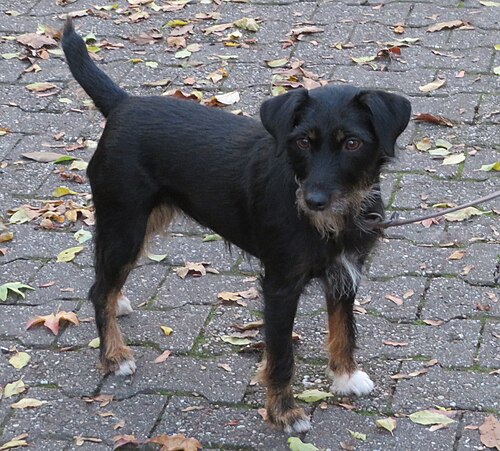
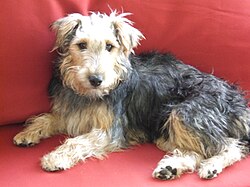
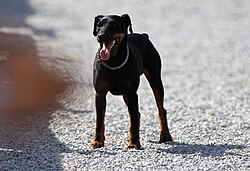
The German Hunting Terrier's coat is smooth or rough, dense and weatherproof and about as easy to care for as it gets – occasional brushing and, for the rough-haired type, a little stripping are enough. Quite different is its need for activity: it needs a great deal of exercise and above all a real task suited to its disposition, ideally hunting. It is hardly suitable for pure family keeping without hunting-related or demanding sporting activity. It is intelligent and capable of learning, but demands experienced, consistent handling that knows how to channel its pronounced will.
🩺 Health
The German Hunting Terrier is a very robust breed, bred consistently for performance and health, with a life expectancy of about thirteen to fifteen years. Serious hereditary diseases are rare, but primary lens luxation, an eye condition for which a DNA test is available, does occasionally occur. Because the breeding is strongly geared towards hunting aptitude, physical fitness and weather-hardiness play a major role. Responsible breeders use the DNA test for lens luxation and select only steady, capable and healthy animals for breeding.
🏡 Who is this breed right for?
The German Hunting Terrier is expressly a dog for active hunters and people who can offer it a real, species-appropriate hunting task – for it, this is not a hobby but the meaning of life. It is generally not suitable for families, beginners, quiet owners or pure apartment keeping, because its drive and hardness lead to problems without suitable activity. It needs plenty of space, exercise and an experienced hand that can guide and involve it. In Switzerland it is kept almost exclusively by hunters and is the wrong choice as a family dog.