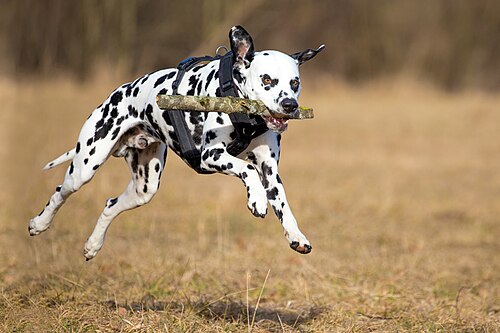
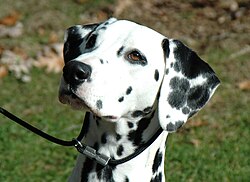
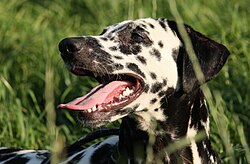
Dalmatian
🧠 Temperament & character
The Dalmatian is lively, intelligent and thoroughly people-oriented — an active dog that seeks the closeness of its family and does not like to be left alone. He has enormous stamina and love of movement and, without enough activity, can become overexcited or develop bad habits. With children he is usually playful and patient, and with other dogs generally compatible. He is sensitive and willing to learn, but can also be strong-willed and needs consistent, loving leadership.
📜 Origin & history
The Dalmatian is an old breed whose exact origin has not been fully clarified; it owes its name to the region of Dalmatia in present-day Croatia. He became famous as a 'carriage dog' that ran beside or beneath the carriages of the gentry, accompanying and guarding the horses. This task explains his enormous stamina and his close bond with horses and people. Later he became a fire-brigade mascot, a show and family dog, and world-famous through films.
✂️ Grooming, care & training
The Dalmatian's short, dense coat is easy to care for, but sheds heavily all year round and needs regular brushing. Considerably more demanding are his exercise needs: he needs a lot of sustained activity every day — long runs, jogging, cycling or dog sports — as well as mental stimulation. An under-challenged Dalmatian quickly becomes restless and can be prone to undesirable behaviour. In training he is intelligent and quick to learn, but sensitive; he needs consistent, motivating and fair leadership without harshness.
🩺 Health
In the Dalmatian, two breed-typical health topics are particularly important: congenital deafness, which can occur on one or both sides and should absolutely be clarified in the puppy by a BAER test, and a disturbed uric-acid metabolism, which can lead to urinary stones (urate) and requires an adapted, low-purine diet. In addition, skin allergies and, rarely, hip dysplasia can occur. Life expectancy is about twelve to thirteen years. Responsible breeders carry out BAER hearing tests, pay attention to the uric-acid metabolism and select the breeding animals carefully.
🏡 Who is this breed right for?
The Dalmatian suits very active, sporty people and families who can offer him plenty of daily exercise and mental stimulation. For comfort-loving owners, for people with little time or for pure kennel keeping he is unsuitable, as he is closely bonded to his family. He can live in an apartment, provided he is kept sufficiently occupied and is not left alone much. In Switzerland he is a popular, sporty family dog and an ideal companion for jogging, hiking and dog sports; good socialisation and a breeder who tests for deafness are important.