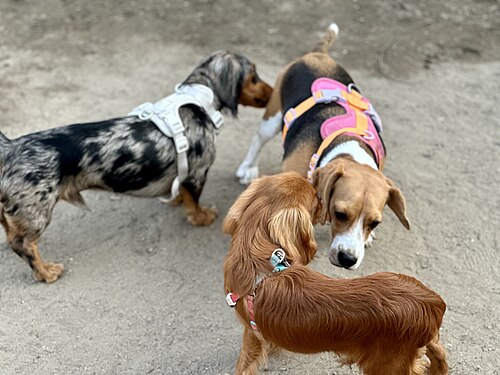
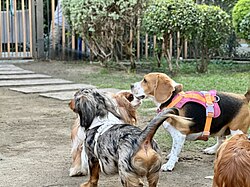
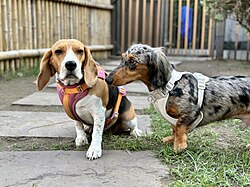
Dachshund
🧠 Temperament & character
The Dachshund is brave, self-assured and lively, with a pronounced will of its own and a strong hunting drive – a small dog with the self-image of a big one. He is affectionate, watchful and loyally attached to his family, but can be reserved towards strangers and likes to raise the alarm loudly. His stubbornness, which once let him hold his own alone in the badger's den, makes training appealing: he wants to be convinced, not commanded. With humour, patience and consistency he becomes a charming, loyal companion.
📜 Origin & history
The Dachshund has a centuries-long history in Germany, where it was specifically bred for the earth hunting of badgers and foxes – its name literally means 'badger dog'. The long, low body and the short legs allowed it to penetrate narrow burrows and corner the quarry there. From this specialisation, three coat types developed – short-haired, wire-haired and long-haired – as well as three sizes, which are divided by chest circumference into standard, miniature and rabbit. In addition to earth hunting, the Dackel is also used for blood tracking and flushing.
✂️ Grooming, care & training
The Dachshund's grooming effort depends on the coat type: short-haired is easy to care for, long-haired needs regular brushing, and wire-haired should be stripped occasionally. Despite its short legs the Dackel needs regular but moderate exercise as well as mental activity – as a hunting dog it loves nose games and tracking work. Absolutely crucial is protecting the long back: stairs, high jumps and excess weight should be strictly avoided. In training patience is required, for the clever Dackel likes to think for itself and is best motivated playfully.
🩺 Health
The Dachshund reaches an age of around 12 to 15 years, but its greatest health risk is typical of the breed: the intervertebral disc herniation (IVDD), caused by the long back and the special body shape (chondrodystrophy). A lean weight, avoiding stairs and jumps as well as back-friendly exercise are the most important preventive measures. In addition, eye diseases (in certain colour variants), epilepsy and heart problems can occur. Responsible breeders avoid extreme forms and risky pairings and pay attention to healthy backs.
🏡 Who is this breed right for?
The Dachshund is a versatile companion that feels at ease in an apartment as well as a house, as long as its back is protected and it is kept busy every day. It suits active individuals, couples and families with older, sensible children who take its stubbornness with humour. For first-time owners it is manageable if they are willing to train consistently and patiently. In Switzerland it is a popular, robust companion for leisurely hikes and nature outings – whereby its hunting drive requires a reliable recall and securing in the forest.