Curly Coated Retriever
🧠 Temperament & character
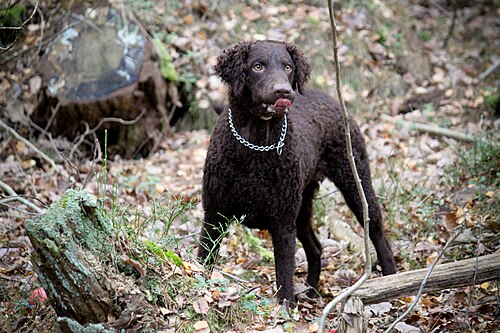
The Curly Coated Retriever is self-assured, intelligent and considerably more independent than the Golden or the Labrador. Towards his family he is loyal and loving, while towards strangers he shows himself rather reserved and watchful. He is balanced and not effusive, likes to think along and needs a task. With fair, varied training he is a reliable, sensitive partner.
📜 Origin & history
The Curly Coated Retriever arose in the 18th and early 19th centuries in England and is regarded as the oldest recognised retriever breed. His breeding presumably drew on the English Water Spaniel, the extinct St. John's Dog and later probably also the Poodle, which explains the characteristic curls. As a robust retrieving dog for water and feathered game he was valued by hunters early on. With the rise of the Labrador and the Golden he became rare, but to this day has loyal followers.
✂️ Grooming, care & training
The curly coat of the Curly Coated Retriever is astonishingly easy to care for: it is not brushed but only shaped when damp, so that the curls are preserved; during the moult he sheds nonetheless. As a work-loving retriever he needs plenty of exercise, swimming and retrieving work as well as mental occupation. He is capable of learning but independent – monotonous drilling quickly bores him. Varied, motivating training brings out his cooperation best.
🩺 Health
The Curly Coated Retriever is overall robust and reaches an age of about 9 to 12 years. Hip and elbow dysplasia, eye diseases such as PRA and cataracts as well as epilepsy can occur; in some lines a hereditary glycogen storage disease (GSD IV) appears, which is avoidable by genetic test. Reputable breeders examine joints and eyes and use the available genetic tests.
🏡 Who is this breed right for?
The Curly Coated Retriever suits active people and families who appreciate an intelligent, somewhat independent dog and can offer him exercise, water and tasks. For first-time owners he is doable if they are prepared to accompany his independence with fair training. Ideal is a home with a garden and closeness to nature, but active apartment living is also possible. In Switzerland he is rare and rather something for committed retriever enthusiasts.