Chihuahua
🧠 Temperament & character
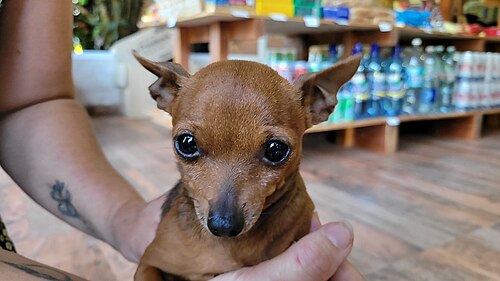
The Chihuahua is self-confident, alert and astonishingly courageous – he often has no idea how small he is. He bonds strongly with one person, whom he loyally follows, and can be reserved or suspicious towards strangers. Without consistent training and early socialisation he tends to defend his little kingdom loudly. Properly guided he is a lively, affectionate and intelligent companion with a big character.
📜 Origin & history
The Chihuahua is considered a descendant of the Techichi, a small dog of the Toltecs and Aztecs that had ritual significance in ancient Mexico. He received his present name in the 19th century from the Mexican state of Chihuahua, where American travellers discovered the little dogs and took them along. From there the breed began its triumphal march into the USA and later to Europe. It exists in a short-haired and a long-haired variety.
✂️ Grooming, care & training
Care depends on the coat variety: the short-haired Chihuahua is very easy to care for, the long-haired Chihuahua needs regular brushing. His need for exercise is low, but daily walks and play are important so that he stays physically and mentally occupied. Despite his size he needs real training – he should be treated like a proper dog and not allowed to get away with everything. Because of his sensitivity to cold, a coat is often sensible in the Swiss winter.
🩺 Health
The Chihuahua can live to a great age, with a life expectancy of around 12 to 18 years. Typical for the breed are patellar luxation, dental problems due to the crowded set of teeth, occasionally hydrocephalus (water on the brain), tracheal collapse and a sensitivity to cold. In some puppies the fontanelle on the skull remains open. Reputable breeders pay attention to kneecaps, heart and a stable temperament and avoid extreme 'teacup' breeding, which is especially prone to health problems.
🏡 Who is this breed right for?
The Chihuahua is superbly suited to an apartment and to people looking for a small, portable companion – including seniors and city dwellers. For families with very small children he is less ideal because of his fragility; he needs considerate handling. As a first dog he is possible, provided he is taken seriously and trained consistently rather than pampered. In Switzerland he is a practical city dog, but one that needs warmth, company and clear rules.