Chesapeake Bay Retriever
🧠 Temperament & character
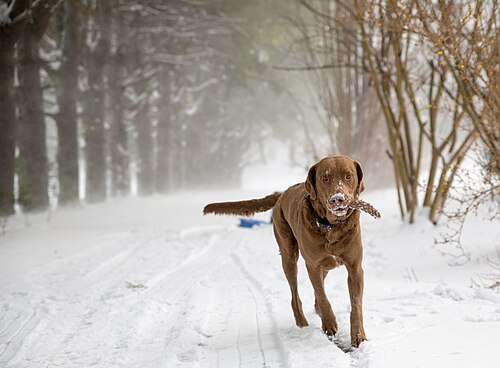
The Chesapeake Bay Retriever is self-assured, enduring and considerably more independent than other retrievers. Towards his family he is loyal and affectionate, but reserved and watchful with strangers, with a pronounced protective instinct. He is a strong-willed working dog who needs consistent, confident leadership and early socialisation. Correctly guided, he is a reliable, courageous and performance-loving companion.
📜 Origin & history
The breed goes back to two Newfoundland-like dogs that were rescued from a shipwreck off the coast of Maryland in 1807 and mated with local retrieving dogs. On the rough Chesapeake Bay an extremely weatherproof dog developed from them, one that could retrieve hundreds of ducks a day amid ice and waves. His oily, dense coat and powerful build made him the indispensable helper of waterfowl hunters. Today he is valued in the USA but rarely encountered in Europe.
✂️ Grooming, care & training
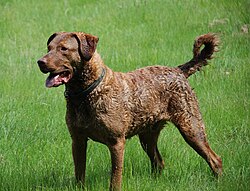
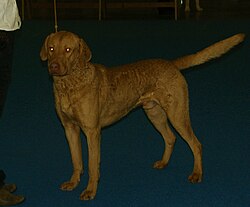
The Chesapeake's short, dense and slightly oily coat is water- and dirt-repellent and easy to care for; regular brushing is enough, and frequent bathing should be avoided in order to preserve the natural protective film. During the moult he sheds heavily. As a powerful working dog he needs a great deal of exercise, preferably with swimming and demanding retrieving work. Mental stimulation and clear, fair training are especially important for this strong-willed character.
🩺 Health
The Chesapeake Bay Retriever is fundamentally a healthy working breed with a life expectancy of about 10 to 13 years. Conditions that can occur include hip and elbow dysplasia, eye diseases such as PRA, and the neurologically based degenerative myelopathy. Responsible breeders carry out joint and eye examinations and use genetic tests, for example for PRA and DM.
🏡 Who is this breed right for?
The Chesapeake Bay Retriever is not a dog for beginners; he suits experienced, active people best, those who can offer him clear leadership, plenty of exercise and a task. Ideal is a home with access to nature and water, preferably with a garden. With good socialisation he is a loyal family dog, but his guarding and protective drive calls for a confident owner. In Switzerland he is a rarity and above all something for hunting or dog-sport enthusiasts.