Bloodhound
🧠 Temperament & character
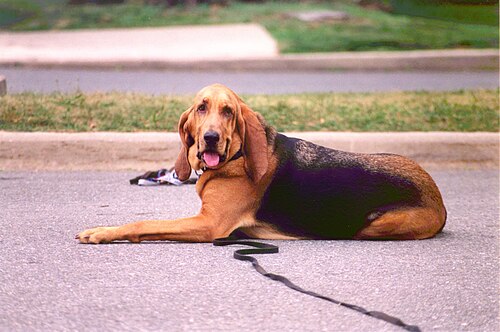
The Bloodhound is gentle, patient and remarkably people-loving - a good-natured giant who is usually loving and easy-going with children. As soon as his legendary nose picks up a scent, however, he becomes extremely independent and is then hardly responsive. He has great stamina but is calm and rather leisurely in the house. His nature is friendly and not very aggressive, but his stubbornness and his irrepressible tracking drive demand a great deal of patience.
📜 Origin & history
The Bloodhound traces back to the monastery dogs of the Abbey of Saint-Hubert in the Belgian Ardennes, where fine-nosed leading hounds were already bred in the Middle Ages. From there the dogs reached England and the whole world, where their unique scenting ability became legendary. For centuries they were used as tracking and leading hounds for the hunt as well as for finding people. Today the Bloodhound is unsurpassed above all in mantrailing and searching for people.
✂️ Grooming, care & training
The Bloodhound's short coat is easy to care for, but his pronounced skin and head folds as well as the long ears require regular, careful cleaning to prevent inflammation and skin problems. He also drools noticeably. He needs plenty of, but joint-friendly, exercise and above all intensive scent work, which occupies him mentally and deeply satisfies him. In training, the gentle but stubborn giant needs plenty of patience, positive motivation and a securely fenced environment, since he follows a trail practically unwaveringly.
🩺 Health
With the Bloodhound an honest look at health is particularly important, since he is one of the shorter-lived breeds, often only eight to ten years. As a large, deep-chested dog he is strongly prone to life-threatening gastric torsion; added to this are ear and eye problems (such as ectropion and entropion), hip and elbow dysplasia and skin-fold inflammation. Because of the high risk of gastric torsion, feeding management and prompt veterinary help are decisive. Responsible breeders x-ray joints, pay attention to healthy eyelids and avoid exaggerated folds and ears.
🏡 Who is this breed right for?
The Bloodhound suits calm, patient people with plenty of space, time and experience who consciously accept his size, his drooling and his irrepressible tracking drive. For a small apartment or for impatient beginners he is little suited, but for a home with a garden and a love of scent work he is ideal. He is remarkably people-oriented and should not be left alone much. In Switzerland he is valued both as a gentle family dog and in mantrailing; outdoors, good securing is essential because of his nose.