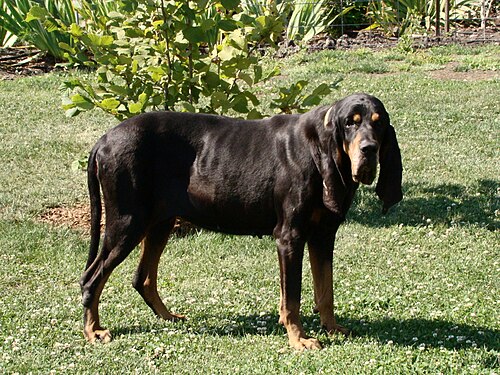
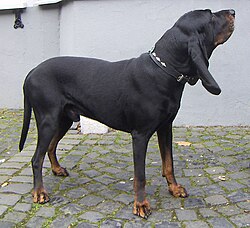
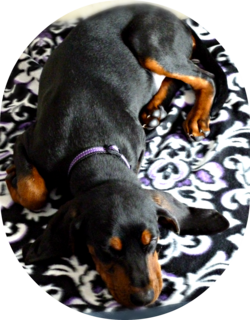
Black and Tan Coonhound
🧠 Temperament & character
The Black and Tan Coonhound is friendly, easygoing and patient - in the house a calm, agreeable companion. On the trail it transforms into an independent, persistent hunter with a loud bay that keeps going for hours. It usually gets on well with children and its own kind, but its strong hunting drive towards small animals remains. It is good-natured, but quite headstrong, and follows its nose with great devotion.
📜 Origin & history
The Black and Tan Coonhound was developed in the USA from ancestors such as the Talbot Hound, the Bloodhound and the Foxhound to hunt raccoons at night in the forests of North America. Characteristic is 'treeing': it drives the game up a tree and bays loudly at it there until the hunter arrives. Over generations it was selected for nose, endurance and cold resistance. It was the first coonhound type to be recognised as a separate breed in 1945.
✂️ Grooming, care & training
The short, dense coat of the Black and Tan Coonhound is weatherproof and easy to care for; regular brushing is enough. Its need for exercise is high: it needs extensive daily exercise and above all intensive nose work to be balanced. The long drop ears must be checked and cleaned regularly, as they are prone to infection. In training, the independent, stubborn hunter needs plenty of patience, motivation and a securely fenced area, since it otherwise follows a trail undeterred.
🩺 Health
The Black and Tan Coonhound usually reaches an age of ten to twelve years. Among the more common issues are chronic ear infections due to the long ear leathers as well as hip dysplasia; as with larger, deep-chested breeds, the risk of gastric torsion should also be kept in mind. Occasionally eye problems (such as ectropion) occur. Responsible breeders x-ray hips and elbows, check the eyes and pay attention to healthy, work-capable animals.
🏡 Who is this breed right for?
The Black and Tan Coonhound suits active, patient people with plenty of space and a love of nose work, ideally with a hunting or sporting background. For a city apartment it is little suited because of its loud voice and need for exercise, but for rural conditions with a garden it is well suited. It is sociable and should not be left alone much. In Switzerland it is rare; because of its strong hunting drive and loud voice, off-leash freedom and the neighbourhood must be carefully considered, and the cantonal leash rules must be observed.