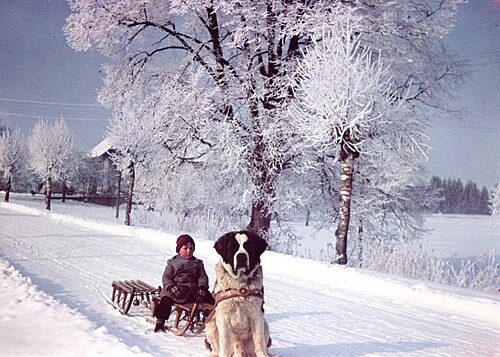
St. Bernard
🧠 Temperament & character
The St. Bernard is very gentle, friendly and self-assured, while also attentive and protective towards his family. Despite his enormous size he is balanced and patient, especially in his dealings with children, with whom he is usually touchingly careful. He can be strong-willed and therefore needs early, friendly training and consistent boundaries. With other dogs and animals he usually gets on well. As a good-natured giant he is not an aggressive guard, but his presence alone commands respect.
📜 Origin & history
The St. Bernard owes its name to the hospice on the Great St. Bernard Pass in Valais, where monks kept powerful dogs from the 17th century onwards. These accompanied travellers and searched the snow for people who had been buried, becoming legendary avalanche and rescue dogs. The most famous of them, Barry, is said to have saved numerous people and remains a symbol of the breed to this day. Today the St. Bernard is above all a family dog; the Fondation Barry continues his tradition in Valais, for example in animal-assisted social work.
✂️ Grooming, care & training
The St. Bernard comes with a short (double) coat or a long coat; both varieties shed heavily and need regular brushing, more frequently during the moult. He also tends to drool, which is part of the breed and should be factored in. His exercise needs are moderate: daily walks are enough, but as a puppy and young dog, strain, stairs and heat must be strictly rationed to protect the sensitive joints. Early, consistent training is crucial, because what looks cute in a puppy is hard to correct in a fully grown giant.
🩺 Health
Like many giant breeds, the St. Bernard unfortunately has a short life expectancy of around eight to ten years and several serious health risks. These include hip and elbow dysplasia, bone cancer (osteosarcoma), the life-threatening gastric torsion, and eyelid defects such as entropion and ectropion. Responsible breeders X-ray hips and elbows, check eyes and heart, and choose breeding animals with a healthy, moderately heavy build. Owners should avoid overweight and know the signs of gastric torsion.
🏡 Who is this breed right for?
The St. Bernard suits families and people with enough space, time and calm for a gentle giant — a house with a garden is ideal, a small city apartment unsuitable. His peaceful nature makes him possible in principle even for well-informed first-time owners, but the sheer size, the costs and the short lifespan should be considered realistically. He loves his home and his family and needs close contact rather than kennel life. As a living piece of Swiss cultural heritage, he rewards responsible owners with deep affection and gentleness.