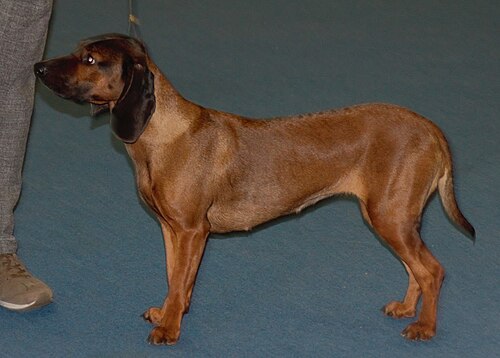
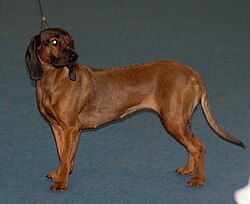
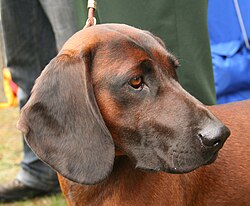
Bavarian Mountain Scenthound
🧠 Temperament & character
The Bavarian Mountain Scenthound is calm, even-tempered and strongly focused on his handler – a working dog with a deep bond and great sensitivity. On the trail he works independently, with concentration and enormous endurance. Towards strangers he is rather reserved, and at home calm and unobtrusive. He is no spirited daredevil, but a level-headed, thorough specialist who needs a close partnership with his person.
📜 Origin & history
The Bavarian Mountain Scenthound was developed in Bavaria in the 19th century to create a lighter, more agile tracking dog for the difficult mountain terrain. For this the heavier Hanoverian Scenthound was crossed with light native mountain hounds. The aim was a dog that could still reliably work out the blood trail of wounded hoofed game even after a long time. To this day he is a highly specialised working gun dog kept almost exclusively in the hands of hunters.
✂️ Grooming, care & training
The Bavarian Mountain Scenthound's short, dense coat is weatherproof and very easy to care for; occasional brushing is enough. In terms of stimulation, on the other hand, he is demanding: he needs not only physical exercise but above all meaningful scent work and a real task, ideally in the hunting sphere. Without this activity a dog of this specialised breed is under-challenged. In training he is easy to handle thanks to his close bond, but needs a calm, knowledgeable hand and plenty of shared work.
🩺 Health
The Bavarian Mountain Scenthound is regarded as robust and healthy overall and usually reaches an age of twelve to fourteen years. Breed-typical hereditary diseases are rare; hip dysplasia occurs occasionally, and as with all active hunting dogs the ears, eyes and paws should be checked regularly. Thanks to the functional breeding for performance, the gene pool is comparatively healthy. Responsible breeders x-ray the hips and place value on temperamental soundness and working aptitude.
🏡 Who is this breed right for?
The Bavarian Mountain Scenthound is a highly specialised hunting dog and clearly belongs in the hands of hunters or at least in an environment with intensive scent work. He is not suited to being kept purely as a family or apartment dog without a hunting task, since he would otherwise be under-challenged and unhappy. In Switzerland he is kept above all by hunters for tracking wounded game and is highly valued by them. Anyone who offers him a real task, plenty of shared work and a close bond gets a loyal, even-tempered partner.