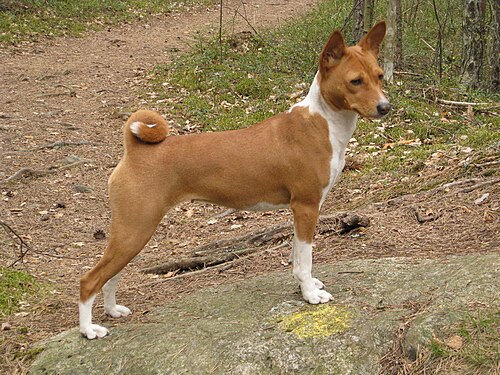
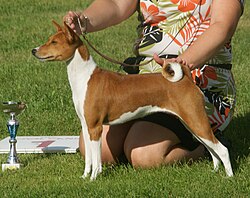
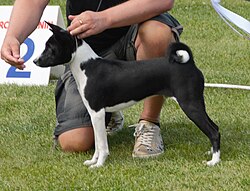
Basenji
🧠 Temperament & character
The Basenji is independent, intelligent and remarkably self-reliant – in his nature he strongly recalls a cat: curious, clean and with a mind of his own. Towards strangers he is reserved, but affectionate and playful with his family. He does not bark, but expresses himself through a characteristic yodel, whining and chuckling. His strong hunting and prey drive as well as his independence make training intriguing: the Basenji does not follow blindly, but wants to be convinced and led respectfully.
📜 Origin & history
The Basenji is one of the oldest and most primitive dog breeds in the world and comes from Central Africa, in particular the Congo region. There he was used by local peoples as a versatile hunting dog that tracked game and drove it into nets; he often wore a bell so he could be located in the dense jungle. His catlike cleanliness and the fact that, typical of wild dogs, the females usually come into season only once a year testify to his primitive origins. In the 20th century he reached the West.
✂️ Grooming, care & training
The Basenji's short, fine coat is extremely easy to care for; he cleans himself like a cat, barely smells and sheds little. All the more important is keeping him occupied: the Basenji is an enduring, fast hunting dog with a high need for exercise that needs plenty of daily running and mental occupation. Because of his enormous prey drive a reliable recall is difficult – in many places he runs free only in secured areas. He is intelligent but wilful; training works best in a playful, motivating way and with a great deal of patience. His short coat also makes him sensitive to cold.
🩺 Health
The Basenji has a life expectancy of around 12 to 14 years, but is known for some serious hereditary diseases. The most important is Fanconi syndrome, a hereditary kidney disease for which a DNA test exists. Also widespread are hereditary haemolytic anaemia due to pyruvate kinase deficiency (PK deficiency, DNA test available) and progressive retinal atrophy (PRA), which can lead to blindness. Responsible breeders consistently use the available DNA tests and have the eyes examined – a central point when choosing a puppy.
🏡 Who is this breed right for?
The Basenji suits experienced, active people who appreciate his catlike independence and know how to handle his hunting drive and his urge for freedom. For first-time owners who expect classic obedience he is usually a challenge. He can live in an apartment, provided he gets enough exercise and occupation, but he likes to escape and needs secure fencing. He gets on well with older, respectful children. In Switzerland his sensitivity to cold should be considered and he should be given protection in winter.